
Proudly serving the Greater Northern VA area
Comfenergy Before & After Photos
Click on a photo to enlarge.
Fiberglass versus Spray Foam-Leesburg, VA


This before photo shows a vertical wall in an attic insulated with fiberglass insulation. This fiberglass allows hot/cold air to travel through it and touch the drywall, thus allowing the heat and/or cold to transfer into the living space.
The after picture shows the fiberglass removed and newly insulated using closed cell spray foam. This builds a great protective thermal and air barrier and makes the top floor of this home cooler in the summer months.
Mold Treatment- Leesburg, VA


This Leesburg, VA homeowner had mold growing in their vented attic assembly that was causing the family to develop allergies and get sick very often. Comfenergy discovered this attic mold and treated it with MoldX-2 before air sealing, insulating and providing other services.
These pictures ar eof the mold covered roof joists before and after being treated by Comfenergy with MoldX-2.
Home efficiency improvement in Leesburg


These clients were interested in improving the overall efficiency of their home. They had uneven temperatures from room to room and poor airflow through the house. Don Calnen performed a home inspection and identified the need for improved insulation and air sealing in the attic. We removed the old insulation, installed several can light covers and then air sealed with ZypFoam. The knee walls in the attic were fitted with foam boards to seal and insulate before the rest of the attic was filled with TruSoft blown cellulose insulation.
Leesburg VA Attic Insulation and Air Seal
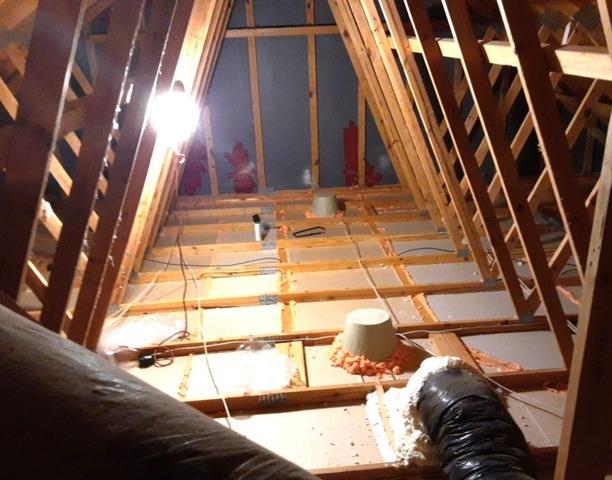

This Leesburg VA home was uncomfortable to the homeowners. They called us to get help and our Home Performance Sale Pro Eric went out to perform a no cost whole home inspection to try and find a solution to their problems. The attic had insulation that was not getting the job done. The performance level of the existing insulation (otherwise known as R Value) was less than what would be needed for the type of home and space in the attic along with the fact that the attic was not air sealed. This meant that conditioned air made by the HVAC system was being allowed to escape from the rooms it was made to cool down or heat up, causing the HVAC system to run more and use up more energy. Our production crew came and removed the existing insulation, then used Zyp Foam to create an air seal around the cracks and can light fixtures that accessed the rooms below. They would then install Rock Wool insulation to cover the base of the attic and then blow in Tru Soft Cellulose insulation to fill the space to its needed R Value. Shown here is the attic at the mid way point in the project when the existing insulation was removed and the air seal had been completed. Then shown as after is the finished project with Tru Soft insulation covering everything.
Leesburg VA Attic Insulation Panels


Builder grade material is often not what is needed to deliver top level home performance. Builder grade is what most home builders use because it "meets code" and will pass the test of "is this home livable?" We offer solutions to improve home performance and provide a comfort and quality that is leaps and bounds above what "code" will deliver. This attic wall was found to be doing a poor job of keeping outside temperatures from impacting the attic which was also the case with the walls of the rooms in the home below. We installed Silver Glo insulation panels to the wall and then air sealed them with Zyp Foam to create an air seal.
our service area
We serve the following areas
- Amissville
- Berryville
- Bluemont
- Boston
- Boyce
- Brandy Station
- Burr Hill
- Castleton
- Chester Gap
- Clear Brook
- Cross Junction
- Culpeper
- Delaplane
- Elkwood
- Farmville
- Flint Hill
- Front Royal
- Gore
- Hume
- Huntly
- Jeffersonton
- Lignum
- Linden
- Louisa
- Markham
- Marshall
- Middletown
- Mineral
- Mitchells
- Orange
- Paris
- Purcellville
- Rapidan
- Remington
- Rhoadesville
- Rixeyville
- Round Hill
- Stephens City
- Stephenson
- Stevensburg
- Unionville
- Upperville
- Warrenton
- Washington
- White Post
- Winchester
